The Magic of Moses
Prophet, Sorcerer, and Master of Divine Power
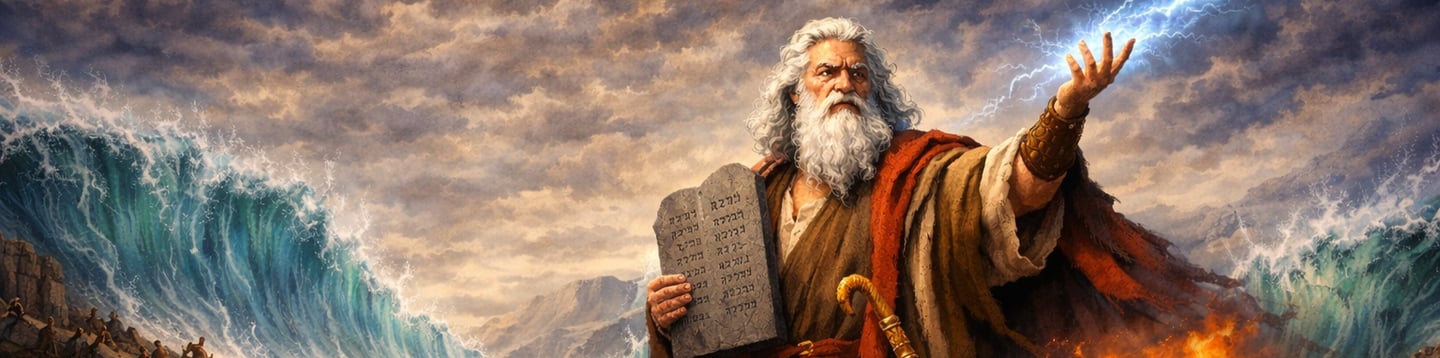
Few figures in the ancient world command as much magical authority as Moses. Across Hebrew scripture, Hellenistic legend, rabbinic lore, Greek magical papyri, and Gnostic tradition, Moses stands not merely as a prophet or lawgiver, but as one of the supreme magicians of human history, a man who commanded serpents, divided seas, drew water from stone, called plagues down on empires, and ascended into the divine presence itself. To understand the magic of Moses is to trace the deep roots of Western esotericism, for his arts flow into virtually every stream of sacred power that followed.
Moses in the Egyptian Context
The opening drama of Moses’s magical life takes place in the court of Pharaoh, which the Hebrew text presents as a theater of competing sorceries. When Moses and his brother Aaron confront Pharaoh, Aaron casts his staff to the ground and it becomes a serpent, a nachash, the same word used for the serpent of Eden. Pharaoh’s magicians, the chartumim, replicate the feat with their “enchantments” (lahat). But Aaron’s serpent swallows theirs. The contest is not between miracle and magic; it is between one magical tradition and another, with the Mosaic tradition proving supreme.
This framing is significant. The Egyptian magicians are not dismissed as frauds or illusionists. Their power is granted as real. What distinguishes Moses is not that he operates outside magic, but that he operates within a more powerful order of it. His access to divine Name-power, the ineffable YHWH, gives his workings an authority that overcomes all rival systems. Ancient audiences would have understood this perfectly: magic was always about hierarchy, about which power stood behind the practitioner.
Greek and Roman writers later understood Moses in explicitly magical terms. Pliny the Elder lists Moses among the founders of magic alongside Zoroaster and Ostanes. The Neoplatonist Apuleius mentions him alongside Iannes and Iambres, the Egyptian sorcerers said to have opposed him. This tradition, drawn from a lost Egyptian priestly source, names the two magicians who matched Aaron's first signs, names eventually preserved in 2 Timothy 3:8. In the Greek Magical Papyri, the name of Moses appears as an invocation of power, suggesting that centuries after his death, his identity had become a source of magical authority in itself.
The Staff of Power
The rod or staff of Moses is one of the great magical instruments of antiquity. In later rabbinic tradition, it became highly mythologized: the Mishnah’s Pirkei Avot lists the staff of Moses among ten miraculous things created at twilight on the sixth day of creation, making it a primordial object woven into the fabric of the world before human time began. It was said to have been passed down from Adam through the patriarchs, finally coming to Moses through his father-in-law Jethro.
The staff performs functions recognizable in comparative magical practice: it is a tool of transformation (serpent), a weapon of elemental power (striking the Nile, the rock, parting the sea), and an object of spiritual combat (Moses holding it aloft during the battle with the Amalekites, his arms raised as a living antenna for divine force). This last episode in Exodus 17 is deeply interesting; the fate of the battle literally rises and falls with Moses’s physical posture. When his arms drop, the Israelites falter; when Aaron and Hur support his arms, they prevail. The body of the magician is here an instrument of power, his gesture a sustained working.
The Rod and the Serpent
The transformation of the staff into a serpent, and back again, resonates with Egyptian magical symbolism. The uraeus, the rearing cobra worn on the crown of Pharaoh and the gods, was the supreme emblem of royal and divine power. To command serpents was to command the primal force of sovereignty. Moses’s mastery over the serpent-form of his own staff suggests a claim to precisely this order of power, a power that supersedes Pharaoh’s own divine mandate.
Later, in the wilderness, Moses is commanded to craft a bronze serpent on a pole, the Nehushtan, so that any Israelite bitten by the plague of fiery serpents might look upon it and live. This is talismanic magic of the most ancient kind: the creation of an object charged with healing power, a counter-image that absorbs or neutralizes the affliction. The Nehushtan was preserved in the Jerusalem Temple and venerated for centuries until King Hezekiah destroyed it, indicating it had become an object of popular devotion and ritual use.
The Plagues as Ritual Combat
The ten plagues of Egypt are best understood not as arbitrary displays of divine wrath but as a structured ritual combat, a systematic assault on the divine powers of Egypt itself. Each plague targets a god. The Nile turned to blood attacks Hapi, the god of the Nile's flooding. Darkness assaults Ra, the solar deity on whom Egyptian cosmology most fundamentally rested. The death of the firstborn strikes at Osiris, at pharaonic succession, at the divine lineage of Egypt’s ruler. Moses functions here as a ritual specialist engaged in what modern scholars of magic would call “counter-magical warfare”, systematically dismantling the sacred infrastructure of a rival religious system.
This reading aligns with ancient Jewish interpretation. The Haggadah, read at Passover, treats the plagues as structured and significant in their order and symbolism. The Midrash elaborates magical and cosmic dimensions that the brief biblical text leaves implicit. In the Gnostic tradition, particularly in texts like the Testimony of Truth and works associated with the Sethian school, Moses’s confrontation with Egypt becomes a mythological drama of consciousness against enslaving powers, the archons who rule the material world.
Moses in Jewish Magical Tradition
The Sword of Moses
Among the most remarkable esoteric texts to survive from late antiquity is Ha-Harba de-Moshe, “The Sword of Moses,” a Hebrew magical text likely compiled between the 4th and 7th centuries CE but drawing on much older material. It presents Moses as the supreme celestial magician who, during his forty days on Sinai, received not only the Torah but a secret sword, an angelic name-formula of overwhelming power, along with an extensive repertoire of spells for healing, protection, cursing, and commanding demons. The text instructs that this sword was entrusted to Moses by the angel Metatron (or in some versions, by the divine presence directly) and that through it, Moses performed all his wonders.
The text is practical in orientation, it contains actual formulas meant for use, but its framing is profoundly theological. Moses’s magic is derived magic: it flows from his intimacy with the divine Name and with the angelic hierarchy. He is not a sorcerer who compels the gods; he is a prophet whose profound alignment with the divine source gives him legitimate command over all other powers. This distinction, between compelling and aligning, between binding and harmonizing, runs through all serious Western magical theory down to the present.
Moses and the Divine Name
The central magical resource of Moses is the Name of God, the Tetragrammaton, YHWH, the four letters whose correct pronunciation was held to be the key to creation itself. In rabbinic tradition, Moses’s ability to perform wonders was inseparable from his knowledge of and relationship with this Name. The magician who knows the Name of a power has authority over it; Moses’s unique intimacy with YHWH, described in Numbers 12:8 as speaking “mouth to mouth” with God, seeing the divine “form” directly placed him in a class apart from all other prophets and all other workers of wonders.
This theology of the divine Name as the source of magical power became foundational for Jewish mysticism, particularly the Merkabah and Hekhalot traditions, and flows directly into the Kabbalistic tradition. The Sefer Yetzirah’s meditations on the creative power of the Hebrew letters, the elaborate angelic hierarchies of the Hekhalot texts, the magical Name-combinations of practical Kabbalah, all trace back to a Mosaic prototype: the man who stood in the burning fire of the divine presence and came away alive, bearing letters of fire that could reshape the world.
Moses in Gnostic and Hermetic Tradition
Gnostic literature treats Moses with a complexity that reflects the broader Gnostic ambivalence about the Hebrew creator-god. In some Gnostic systems, Moses is an agent of the Demiurge, a lawgiver whose role is to bind souls more tightly to the material world. But in other streams, particularly those most sympathetic to Jewish mysticism, Moses is a figure of genuine illumination, a soul who pierced through the Demiurge’s veil and glimpsed the true light beyond.
The Gnostic text On the Origin of the World and the Apocryphon of John reinterpret Mosaic narratives in the light of Gnostic cosmology, sometimes making Moses a vehicle for Sophia’s wisdom, sometimes complicating his authority. The Nag Hammadi library as a whole shows a community deeply engaged with Mosaic tradition, arguing with it, reimagining it, finding in its symbols a language for the drama of spiritual awakening. For the Gnostic, Moses’s ascent of the mountain, his entry into the darkness where God dwells, and his vision of the divine form are all initiatory events, experiences of the living gnosis that the institutional religion had calcified into law.
The Hermetic tradition, overlapping with Gnosticism and Neoplatonism, similarly elevated Moses as a master of theurgy, the art of drawing divine powers down into the material world for transformative purposes. The burning bush, in this reading, is not merely a narrative miracle but an initiatory symbol: the soul that burns without being consumed, the practitioner who stands in the divine fire and is not destroyed but illuminated.
Legacy
The magical tradition of Moses did not end in antiquity. It flows through the medieval grimoires, through the Key of Solomon (which claims Solomonic authority but draws heavily on the Mosaic magical vocabulary), through the Christian ceremonial magic of the Renaissance with its Hebraic divine Names and angelic hierarchies, and into modern Western esotericism. Aleister Crowley explicitly acknowledged Moses as a supreme adept. The Hermetic Order of the Golden Dawn’s elaborate ritual system is saturated with Mosaic symbolism, from its use of the Tetragrammaton to its initiatory grades structured around Kabbalistic correspondences.
What makes Moses enduring as a magical figure is the combination of radical intimacy with divine source and radical effectiveness in the world — the mystic and the magician fused into one. He does not merely contemplate the divine fire; he carries it down the mountain and uses it to liberate a people, reshape a landscape, and found a civilization. His magic is not private illumination but world-altering power rooted in profound relationship with the ground of being. For any tradition that takes both inner transformation and outer action seriously, Moses remains the archetype: the one who spoke with God as a man speaks with his friend, and whose words could split the sea.
I Believe in Magic
© SDBEST LLC, 2025. All rights reserved.
Privacy Policy
Sponsorship Disclosure
Cookie Policy
Disclaimer