The Magic of Pythagoras
Philosopher, Wonder-Worker, and Master of Number and Harmony
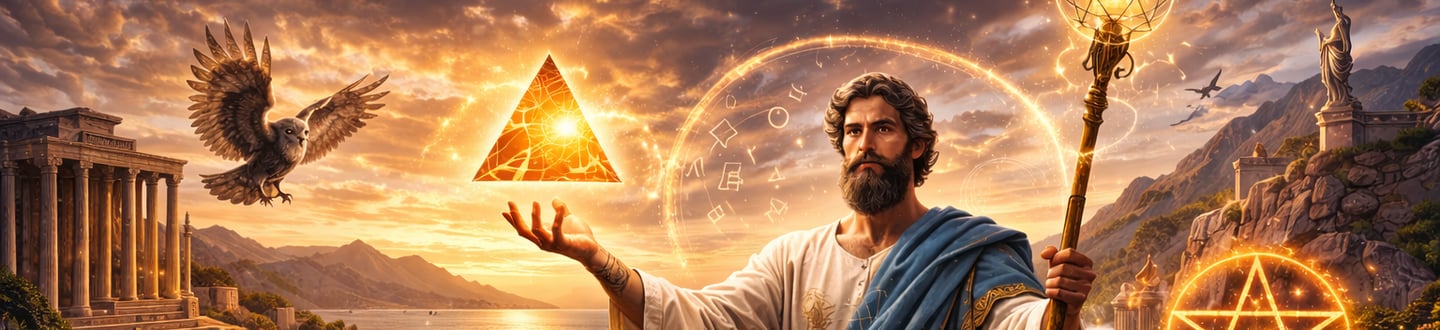
In the Western imagination, the name Pythagoras conjures a theorem about triangles, a dry fact of school geometry. But to the ancient world, Pythagoras of Samos was something altogether more extraordinary: a semi-divine sage, a worker of wonders, a man who had descended into the underworld and returned, who could be in two places at once, who calmed animals with his voice, who heard the music the stars made in their orbits, and who possessed a golden thigh that proved his divine nature to anyone who doubted it. He was, in the fullest ancient sense of the word, a magician ,not in the sense of a trickster but in the sense of a man whose mastery of hidden principles gave him power over the natural and spiritual world. His philosophy and his magic were one and the same art.
The Mythological Pythagoras
The historical Pythagoras, born on the island of Samos around 570 BCE, active in Croton in southern Italy, founder of a philosophical and religious community that combined rigorous mathematical study with strict ascetic practice, is almost impossible to separate from the legendary figure that began accumulating around his name almost immediately after his death. He wrote nothing, and his earliest followers treated his teachings as secret doctrines to be transmitted only within the brotherhood. By the time substantial biographical accounts were composed, notably by Iamblichus, Porphyry, and Diogenes Laërtius in the third century CE, the man had been marinating in myth for eight hundred years.
The legends are consistent in their basic shape. Pythagoras was the son of Apollo, or at least specially favored by that god. He had studied in Egypt under the priests, in Babylon under the Magi, in Phoenicia, in Arabia, and perhaps even in India ,a circuit of the ancient world’s great wisdom traditions that made him a synthesis of all esoteric knowledge. He was recognized as the reincarnation of Euphorbus, a Trojan warrior, and of other souls besides ,a living demonstration of the metempsychosis, the transmigration of souls, that was central to his teaching. He remembered all his previous lives. He had descended into the realm of Hades, seen the punishments of the wicked and the rewards of the virtuous, and returned to the living world with firsthand knowledge of what awaited after death.
These are not incidental ornaments to his philosophical reputation. They are integral to how the ancient world understood what he was. A man who had traveled to every source of wisdom, who remembered the full arc of his soul’s journey through many lives, who had stood in the underworld and returned ,such a man did not merely theorize about the structure of reality. He knew it from the inside. His philosophy was not speculation but report.
The Golden Thigh and the Divine Body
Among the physical signs of Pythagoras’s divine nature, the most celebrated was his golden thigh. According to Iamblichus and other sources, Pythagoras once showed his thigh to Abaris the Hyperborean ,himself a legendary shaman-figure said to fly through the air on a golden arrow ,as proof that he was Apollo’s son or avatar. The two sages reportedly recognized each other as kindred beings. The golden thigh is a mark of the theios aner, the “divine man”, a category that ancient Mediterranean culture used for figures who stood at the boundary between human and divine nature, whose bodies themselves bore witness to their exceptional status.
This physical supernaturalism extends through many of the Pythagorean legends. He was reportedly seen in two cities on the same day ,Croton and Metapontum ,simultaneously, a feat of bilocation that later hagiographic tradition would also attribute to saints and holy men. A river addressed him by name as he crossed it. He predicted earthquakes and plagues. He calmed a bear in Daunia by whispering in its ear and stroking it, and thereafter the bear was peaceful toward all living things. He turned away a bull from a field of beans not by force but by whispering in its ear. He charmed an eagle from the sky by holding up his hand.
These animal stories are not merely charming folklore. They encode the Pythagorean conviction that all living things share in a common soul-substance, that the barriers between species are permeable to one who has achieved sufficient understanding of the underlying unity. The man who comprehends the harmony of the cosmos can speak to any creature within it because he speaks from the ground of their shared nature. His power over animals is his philosophical insight made physically operative ,which is precisely the definition of magic in the Neoplatonic tradition: philosophy actualized, wisdom that works.
Number as the Architecture of Reality
The Tetractys
At the heart of Pythagorean philosophy and its magical implications lies the doctrine that number is the principle of all things ,not merely that things can be counted or measured, but that the deep structure of reality is numerical, that the ratios and proportions that govern mathematics are the same ratios and proportions that govern music, astronomy, the human soul, and the cosmos as a whole. This is not a metaphor. For Pythagoras and his successors, number was ontological: to know the numbers was to know the structure of being.
The supreme numerical symbol of the Pythagorean tradition was the Tetractys ,an arrangement of ten points in four rows (1, 2, 3, 4), forming an equilateral triangle. The Pythagoreans swore their most solemn oaths by it: “By him who gave to our generation the Tetractys, which contains the fount and root of eternal nature.” The ten points encode the first four numbers, which sum to ten, the number of completion. They also encode the fundamental musical ratios: the ratio 2:1 (the octave), 3:2 (the perfect fifth), 4:3 (the perfect fourth). The Tetractys was thus simultaneously a cosmological diagram, a musical theory, a mathematical symbol, and an object of veneration, a magical figure in the fullest sense, a visual form that participates in the reality it represents.
This use of geometrical figures as objects of contemplative and operative power flows directly from Pythagoras into the later Western magical tradition. The magic square, the pentagram, the Star of David, the various sigils and geometric seals of the grimoire tradition all descend from the Pythagorean insight that spatial arrangement of number is a form of participation in cosmic structure. When a Renaissance magician drew a planetary magic square, a grid of numbers arranged so that every row, column, and diagonal summed to the same value, he was doing Pythagorean magic: using the harmony of number to attract or embody the corresponding planetary intelligence.
The Music of the Spheres
Pythagoras is credited with the discovery ,reportedly made by observing the relationship between the lengths of lyre strings and the pitches they produced ,that musical harmony is founded on simple numerical ratios. But he did not stop at the lyre. He extended the principle outward: if the same ratios that govern consonant sound govern the intervals between the orbits of the planets, then the planets in their courses are producing music. The heavens are a vast instrument, and their motion is a perpetual chord. This is the Harmony of the Spheres, the Music of the Cosmos, inaudible to ordinary human ears, dulled as they are by the noise of embodied life, but perceived by the purified soul and, according to tradition, heard directly by Pythagoras himself.
The magical implications are enormous. If the cosmos is a musical instrument and if number is its principle, then the practitioner who aligns his own inner ratios, through music, through mathematical contemplation, through the regulated life of the Pythagorean brotherhood, enters into resonance with the cosmic harmony. He becomes, in some measure, a tuned instrument himself, vibrating in sympathy with the planetary spheres. This is the theoretical basis for the use of music in ancient and medieval magic: not entertainment or emotional manipulation, but a technology of cosmic attunement. The Pythagorean tradition explicitly used music therapeutically and spiritually, prescribing specific modes and rhythms for specific conditions of soul.
The Pythagorean Brotherhood as Magical Community
The community Pythagoras founded at Croton was not a school in the modern sense but something closer to a religious order, a community of practice organized around shared ritual, dietary discipline, and esoteric study. Members followed elaborate rules governing what could be eaten (no beans, notoriously, among other prohibitions), how one dressed, when one spoke, how one entered and left places, how one treated animals. These rules were not arbitrary. They encoded a magical anthropology: the body is a subtle instrument, and its habits either attune it to the divine harmony or coarsen it away from that attunement.
The prohibition on beans, which became famous in antiquity and has been much mocked since, carried deep symbolic weight. Beans were associated in Greek thought with the souls of the dead ,they were used in funerary rites, and their hollow stalks were thought to provide a passage between the worlds. For a community that took the transmigration of souls with the utmost seriousness, consuming beans was potentially an act of consuming a soul in transit. Whether or not this is the “correct” interpretation, it illustrates the principle: every dietary rule was a magical rule, a regulation of the practitioner’s relationship to the web of soul and matter in which he was embedded.
The brotherhood also maintained strict practices of silence. New initiates observed a period of years ,some sources say two, others five ,during which they could listen but not speak in the master’s presence. This silence was not merely disciplinary. It was an initiatory technology: the aspirant who cannot speak must listen more deeply, must attend to the inner voice, must develop the capacity for interior stillness from which genuine wisdom can arise. The Pythagorean silence is the ancestor of the contemplative traditions of both East and West, and it is continuous with magical practice: the magician who cannot still his own mind cannot hear the subtle harmonics of the world.
Pythagoras and the Shamanic Tradition
Modern scholars, notably E.R. Dodds in his landmark study The Greeks and the Irrational, have argued that Pythagoras belongs to a recognizable type in the ancient world: the shaman-philosopher, a figure whose authority rested not merely on intellectual achievement but on journeys to the otherworld, on the ability to separate the soul from the body and travel to realms inaccessible to ordinary mortals. The parallels with figures like Aristeas of Proconnesus ,who could send his soul out of his body in the form of a raven, and who appeared in two places simultaneously ,are striking. Abaris the Hyperborean, who recognized Pythagoras by his golden thigh, traveled through the air on an arrow of Apollo and was himself a healer and oracle.
These northern shamanic figures, drifting into the Greek world from the steppe cultures beyond the Black Sea, appear to have cross-pollinated with the emerging philosophical tradition in the sixth century BCE. Pythagoras may have absorbed shamanic techniques ,the deliberate induction of trance states, the controlled exit and return of the soul, the use of music to alter consciousness ,and integrated them into a cosmological framework derived from mathematics and musical theory. The result was something genuinely new: a tradition in which the inner journey of the soul and the outer structure of the cosmos were understood as mirrors of one another, and in which the disciplined practice of number and harmony was simultaneously a discipline of soul.
The Pythagorean Legacy in Magic and Esotericism
The influence of Pythagorean thought on the subsequent history of Western magic and esotericism is so pervasive that it is almost impossible to exaggerate. Plato, who absorbed the Pythagorean tradition through his contact with the Italian schools, transmitted it into the mainstream of Western philosophy in a form that shaped every subsequent esoteric tradition. The Neoplatonists, Plotinus, Porphyry, Iamblichus, Proclus, were explicitly Pythagorean in their understanding of number, soul, and the cosmos, and it is the Neoplatonic synthesis that provides the philosophical backbone of Renaissance magic, Kabbalah in its Westernized form, and virtually all serious ceremonial magic down to the present.
Iamblichus, whose life of Pythagoras is the most extensive surviving account, was himself the great theorist of theurgy ,the ritual art of ascending through the hierarchies of being toward union with the One. His Pythagorean biography is thus also a manifesto: it presents Pythagoras as the ideal theurgist, the man whose mathematical and musical practice achieved precisely the soul-elevation that Iamblichus’s own theurgical system aimed at. Pythagoras is, in this reading, not merely a historical figure but a prototype of the perfected philosopher-magician.
The Pythagorean influence on number mysticism is equally profound. Numerology in all its forms, the attribution of qualities and powers to specific numbers, the use of numerical analysis to understand character and fate, the magical use of number in talisman construction and ritual design, traces back to the Pythagorean conviction that number is ontologically real. The Kabbalistic tradition of Gematria, in which the numerical values of Hebrew letters are used to find hidden connections between words and concepts, is Pythagorean in spirit even when its practitioners had no direct knowledge of the Greek tradition. The Renaissance magus Cornelius Agrippa’s Three Books of Occult Philosophy devotes an entire volume to the magical properties of numbers, explicitly drawing on the Pythagorean and Neoplatonic sources. John Dee, the Elizabethan mathematician and angelic communicant, was soaked in the Pythagorean tradition through his study of Proclus and Iamblichus.
The Harmony Within
What makes Pythagoras enduringly compelling as a magical figure is the radical unity of his vision. For him, there was no separation between the mathematics that governed the motions of the stars and the mathematics that governed the intervals of music and the mathematics that governed the proper proportioning of the soul. All of these were expressions of the same underlying Harmony, the logos of the cosmos, the rational principle of ordered beauty that permeated all levels of being from the divine intellect down to the movement of a river or the growth of a shell.
The magical practitioner in this tradition is not someone who compels external forces by force of will or specialized technique. He is someone who has so thoroughly attuned his own inner structure to the cosmic Harmony that he participates in its workings naturally, the way a well-tuned string vibrates in sympathy when its note is played across the room. His wonders, the calmed bear, the addressed river, the bilocation, the healing, the prophecy, are not violations of nature but expressions of nature understood at its deepest level. He is not outside the system; he has moved to its center.
This is the Pythagorean gift to the Western magical tradition: the conviction that the universe is not chaos to be compelled but a harmony to be joined, that the path of the magician is ultimately a path of self-refinement and cosmic attunement, and that the numbers are not abstractions but living powers ,the very language in which the universe speaks itself into being. To know that language, even partially, is to participate in the ongoing act of creation. And to participate in creation, as Pythagoras understood it, is the highest magic of all.
I Believe in Magic
© SDBEST LLC, 2025. All rights reserved.
Privacy Policy
Sponsorship Disclosure
Cookie Policy
Disclaimer