
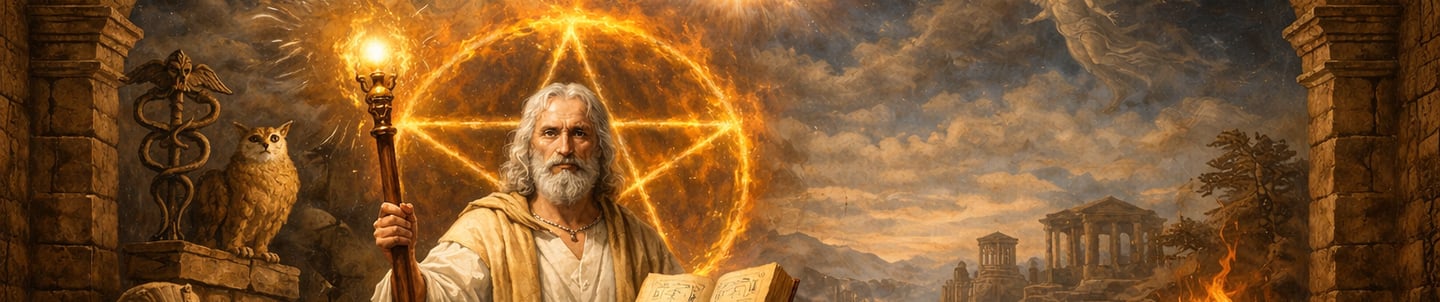
The Magic of Apollonius of Tyana
Neo-Pythagorean Sage, Divine Wanderer, and Wonder-Worker of the Ancient World
In the first century of the common era, as Christianity was taking its first fragile steps across the Roman world, another figure was walking the same roads and leaving behind a trail of wonders that would haunt the imagination of antiquity for centuries. Apollonius of Tyana, born in the small Cappadocian city of Tyana around 15 CE and said to have lived to an age well past a hundred, was a Neo-Pythagorean philosopher, an ascetic of extraordinary discipline, a traveler of almost impossible range, and a worker of miracles whose deeds were gathered, embellished, and set down by the sophist Philostratus in the early third century at the commission of the empress Julia Domna. He raised the dead, expelled demons, stilled plagues, predicted earthquakes and assassinations, vanished from a tyrant’s courtroom in full view of witnesses, and at the end of his long life disappeared from the world entirely, ascending into the divine rather than submitting to the indignity of ordinary death. He was, in the fullest sense the ancient world knew how to mean it, a god walking in human form, or at the very least, a man who had drawn so close to the divine that the boundary had become meaningless.
The Life and Its Source
The primary source for Apollonius is the Life of Apollonius of Tyana written by Flavius Philostratus, composed around 220 to 230 CE and dedicated to the emperor Septimius Severus and his Syrian wife Julia Domna, who was herself a patron of philosophers and a woman of considerable intellectual cultivation. Philostratus claims to have drawn on a memoir written by Apollonius’s companion Damis of Nineveh, a source whose historical existence has been doubted by scholars ever since but which, whether invented or real, provides the biographical narrative its texture of intimate detail and eyewitness vividness.
The historical Apollonius is difficult to isolate from the legendary figure. He was certainly a real person: letters attributed to him survive, he is mentioned by other ancient sources, and the city of Tyana maintained a cult in his honor. He was a Pythagorean philosopher who kept a strict vegetarian diet, wore only linen (never wool, which came from animals), went barefoot, let his hair grow long, and observed periods of silence that in his youth reportedly lasted five years. He traveled to Babylonia, to India, where he visited the sages on the mountain of the Brahmins, to Egypt, to Ethiopia, to Spain, to Rome on multiple occasions, and possibly to the far north. He taught in the great temples and philosophical centers of his world: in Antioch, in Alexandria, in Athens, in Smyrna, in Ephesus, at the Oracle of Trophonius, and at Delphi.
What makes the Life extraordinary as a document is the way Philostratus deploys the Apollonius material against the emerging Christian movement, without ever naming it directly. The parallels between the wonder-working career of Apollonius and the gospel portrait of Jesus are so numerous and so precise that they can hardly be accidental: virgin birth (Apollo himself is implied as Apollonius’s father), a ministry of healing and teaching, the raising of the dead, conflicts with corrupt religious authorities, arrest and trial before an emperor, miraculous release, and final bodily disappearance rather than death. Whether Philostratus was deliberately constructing a pagan counter-gospel or whether both traditions were drawing on a shared repertoire of theios aner, divine man, conventions, the text became one of the most theologically charged documents of late antiquity, cited by pagans against Christianity and requiring detailed refutation by Christian apologists for centuries.
The Pythagorean Foundation
Apollonius’s magic cannot be understood apart from his Pythagoreanism, which was not an academic affiliation but a total way of life. He encountered Pythagorean teaching as a young man studying under Euxenus of Heracleia at Aegae, and he adopted it with the wholeness that would characterize everything he did. The dietary disciplines, the silence, the linen clothing, the refusal of wine, all of these were Pythagorean observances, and their magical significance was the same as in the earlier tradition: the body is a subtle instrument, and its purity or impurity determines the quality of the practitioner’s connection to the divine harmony.
More specifically, Apollonius understood his wonder-working in Pythagorean terms: the sage who has sufficiently purified his soul and aligned it with the cosmic harmony participates in the order of the universe in a way that ordinary embodied consciousness does not. The power to foresee events, to understand the inner nature of things, to communicate with animals, to recognize the presence of demons and dispel them, these abilities flow not from any external gift or learned technique but from the quality of the philosopher’s inner attunement. He did not cast spells. He perceived truly, and true perception, in a Pythagorean universe, is already a form of power.
His five years of silence, observed in his youth and never subsequently broken except from genuine philosophical necessity, are the most revealing detail of his character as a magical practitioner. Silence in the Pythagorean tradition was not merely the absence of speech; it was a discipline of the entire soul, a stilling of the mental noise that prevents the practitioner from hearing the deeper harmonies of the world. The man who has truly learned silence has, in a sense, made himself transparent to reality, and transparency to reality, in this tradition, is what makes miracles possible. Apollonius’s wonders are the fruit of his silence, as much as of any specific technique.
The Journey to India and the Brahmin Sages
The most celebrated episode in Apollonius’s career of wandering is his journey to India, undertaken in the company of Damis early in his philosophical life, to sit at the feet of the Brahmin sages whom the Greek philosophical tradition had long imagined as the possessors of an ancient and perfect wisdom. Philostratus’s account of this journey is one of the great travel narratives of antiquity, blending genuine geographical and ethnographic information with philosophical dialogue and marvelous incident.
The sages he encounters, led by a master named Iarchas, live on a hill that floats two cubits above the ground. They possess a complete knowledge of the movements of the heavens and the inner natures of all things. They converse with Apollonius as an equal, or nearly so, and Iarchas confirms for him the doctrine of metempsychosis that he holds from his Pythagorean training, revealing past lives that Apollonius has lived and explaining the metaphysical architecture of the soul’s journey through successive embodiments. The Indian sages are, in Philostratus’s presentation, the Pythagoreans of the East: a convergent tradition that has reached the same truths by a different path, confirming by that convergence the universal validity of the philosophical wisdom that Apollonius embodies.
Apollonius receives from Iarchas certain gifts and teachings that enhance his already considerable philosophical powers. He returns from India not merely as a more learned man but as a more complete one, a philosopher who has touched the source of wisdom at what the ancient world imagined as its most direct and uncorrupted Eastern origin. The journey to India functions in the Life as an initiatory voyage: Apollonius goes as a student and returns as a master, and from this point in the narrative his wonder-working becomes both more frequent and more dramatic.
The Miracles: A Catalogue of Powers
Raising the Dead
The most theologically resonant of Apollonius’s miracles is his raising of a young Roman bride from apparent death. The girl died on her wedding day, or seemed to die, and her funeral procession was passing through the streets of Rome when Apollonius encountered it. He stopped the procession, touched the girl, spoke certain words over her, and she awoke. Philostratus is careful to introduce a note of ambiguity: perhaps, he suggests, she was not truly dead but in some kind of coma or trance that Apollonius, with his superior perception of vital signs, recognized as such. This careful hedging, offering a natural explanation even for the most dramatic miracle, is characteristic of the philosophical magic tradition: the wonder-worker operates at the boundary of the natural and the supernatural, and the truly wise practitioner understands that this boundary is less absolute than it appears.
The raising is nonetheless presented as a wonder that astonished all witnesses and established Apollonius’s reputation in Rome as someone beyond ordinary human capacity. Whether we read it as the recognition of suspended animation, the restarting of a halted vital process through some occult technique, or a genuine resurrection, the narrative function is the same: Apollonius perceives what others cannot and acts where others are helpless, because his attunement to the principles of life and death exceeds that of any physician or ordinary philosopher.
The Plague at Ephesus
Among the most dramatically vivid episodes in the Life is Apollonius’s halting of a plague at Ephesus. While residing in Smyrna, he suddenly perceives, at a distance of many days’ journey, that Ephesus is suffering from pestilence. He travels there with supernatural speed (Philostratus implies the journey was accomplished more quickly than ordinary travel would permit) and, assembling the Ephesians in their theater, identifies the source of the plague as a single individual: an old blind beggar crouching among them. He orders the crowd to stone the beggar, overcoming their horrified reluctance with the authority of his absolute certainty. When the stones are removed, the dead beggar is revealed to have transformed: beneath the rubble lies not a man but an enormous dog, foam-flecked and monstrous. The plague ceased.
The episode is a demon-expulsion of a very specific ancient type: the pharmakos, or scapegoat ritual, in which the concentrated evil afflicting a community is identified, embodied, and expelled or destroyed. The beggar was a demon, or was possessed by one, whose presence had drawn the pestilence. Apollonius’s ability to see what no one else could see, to identify the hidden spiritual cause behind the visible physical effect, and to act with sufficient authority to compel a skeptical crowd, this is the full suite of the classical wonder-worker’s gifts. The miracle is also, notably, collective rather than individual: Apollonius does not heal Ephesus by himself but through the coordinated action of the entire community, which he directs. His role is diagnostic and authoritative; the execution is communal.
Prophecy and Foreknowledge
Apollonius’s gift of foreknowledge is attested throughout the Life and by sources outside it. He predicted the death of the emperor Domitian at the precise moment it occurred in Rome, while Apollonius himself was in Ephesus, he cried out in the forum that Domitian had fallen, and the news arrived days later to confirm it. He foresaw the assassination of Nerva and communicated his foreknowledge to the conspirators through carefully worded letters. He predicted earthquakes, floods, and famines in specific cities with sufficient precision to allow the populations to prepare. He knew when visitors were coming before they arrived and what they intended to ask.
In the Pythagorean-Neoplatonic framework, prophecy of this kind is not supernatural in any dualistic sense. It is the natural result of a soul sufficiently purified and elevated to perceive the causal structure of events before they manifest in the visible world, to see, in effect, slightly further along the temporal river than ordinary consciousness can reach. The divine intellect perceives all of time simultaneously; the purified human intellect participates in this divine perception to a degree proportional to its elevation. Apollonius’s foreknowledge is his philosophical development made temporally operative: wisdom that works in time as well as in eternity.
The Trial Before Domitian
The climactic episode of the Life is Apollonius’s arrest and trial before the emperor Domitian, whom the Roman tradition remembered as a tyrant and persecutor of philosophers. Apollonius was accused, the specific charges are somewhat vague in Philostratus’s account, but appear to involve treason, divination for political purposes, and general impiety, and brought to Rome in chains. The chains fell from him in prison. He prepared a philosophical defense of great eloquence and delivered it before the emperor, only to vanish from the courtroom at its conclusion, simply ceasing to be present, while witnesses watched, before reappearing later that same day in Puteoli, hundreds of miles away.
The trial scene is the theological heart of the Life and the episode that most directly parallels the Passion narrative of the gospels: the sage of divine origin, falsely accused, arraigned before worldly power, vindicating himself by wisdom and then escaping by miracle. But where the gospel narrative ends in death and resurrection, Apollonius’s version ends in simple disappearance, he does not submit to the world’s power at all, not even momentarily. This is a different theological statement: not the redemptive suffering of the incarnate god but the unassailable freedom of the perfected philosopher, who is so completely himself that no external power can hold him. His body is not a cage but a vehicle, and he can put it down and pick it up at will.
Apollonius and the Demons
Throughout the Life, Apollonius encounters, identifies, and expels demons with an ease that reflects his comprehensive perception of the spiritual world. The most extended demonological episode involves a young student named Menippus who has become entangled with a lamia, a demon in the form of a beautiful woman who feeds on the life-force of her lovers. Apollonius recognizes the creature at a dinner party when all the other guests see only a magnificent house and a beautiful hostess; he perceives that the house is an illusion, the food phantom, and the hostess a demon of the blood-drinking type described in ancient demonological texts. He names her, exposes her, and she vanishes along with all her illusory furnishings.
This story, which Keats immortalized in his poem “Lamia”, is a perfect illustration of the Apollonian magical philosophy: the demon operates through illusion, through the gap between appearance and reality, and the philosopher who perceives truly is immune to its power and capable of dissolving it simply by naming what it is. The exorcism is epistemological before it is ritual: to know the true nature of the thing is already to have broken its hold. Apollonius does not use ritual tools, does not invoke divine names, does not perform any ceremony. He simply sees, and his seeing is sufficient.
This stands in instructive contrast to the exorcistic tradition of both Jewish and early Christian practice, where the expulsion of demons typically involved the invocation of a more powerful name, God, an angel, the name of Jesus. In Apollonius’s case, the authority comes not from an external name but from the internal quality of his perception. He is the power that drives the demon out, not a conduit for any higher force. This philosophical self-sufficiency is both the glory and, for Christian critics, the scandal of the Apollonian tradition: it locates saving power in human wisdom rather than divine grace.
The End: Disappearance and Apotheosis
The death of Apollonius, if it can be called a death, is one of the most remarkable exit narratives in all of ancient biography. Philostratus presents it with deliberate ambiguity and multiple versions, each more marvelous than the last, because the philosophical point requires that Apollonius not die in any ordinary sense. A man who had spent his life demonstrating the soul’s sovereignty over the body could not be permitted to simply age and cease; the conclusion of his life had to be consonant with its content.
The most widely received version has Apollonius, in extreme old age, some accounts say he was nearly a hundred years old, others push further, entering the sanctuary of the goddess Dictynna in Crete, whose sacred dogs lay down and wagged their tails at his approach rather than attacking him as they did all other visitors. He entered the inner sanctuary alone. The doors closed behind him. From within came the sound of singing, female voices, high and joyful, chanting “Hasten from earth, hasten to heaven, hasten.” The doors did not open again. When those outside finally entered, the sanctuary was empty. No body was found. No trace of his passage remained. He had simply ceased to be present in the world, as he had ceased to be present in Domitian’s courtroom, but this time, permanently.
A second tradition records that he appeared to a young student named Damis after his disappearance, not Damis of Nineveh, his old companion, but a younger man of the same name, to resolve a philosophical dispute about the immortality of the soul. The student had been praying to Apollonius for guidance when the sage appeared, spoke the decisive words, and vanished again. This post-mortem appearance, serving a philosophical rather than a personal purpose, is entirely characteristic: even beyond death, Apollonius is primarily a teacher, and his appearances are in service of wisdom rather than sentiment.
The city of Tyana built a temple to him after his disappearance and maintained a cult in his honor for centuries. The emperor Hadrian collected his letters. Alexander Severus placed his image in his private chapel alongside those of Abraham, Orpheus, and Jesus, a revealing grouping that captures exactly how late antiquity categorized him: one of the great divine men, the figures in whom the human form had been penetrated by something that exceeded it. The empress Julia Domna, who commissioned his biography, was herself engaged in a deliberate project of philosophical and spiritual renaissance; Apollonius was her supreme example of what the philosopher could be when philosophy was lived all the way to its conclusion.
Apollonius Against the Christians
The use of Apollonius as a pagan counter to Jesus became explicit in the third century, when the Neoplatonist philosopher Porphyry and the anti-Christian polemicist Hierocles both invoked his career as evidence that the miracles attributed to Jesus were neither unique nor divine in any exclusive sense. If Apollonius had raised the dead, healed the sick, cast out demons, and ascended beyond death without leaving a body, then these feats established no special theological claim for anyone who performed them. The Christian apologist Eusebius of Caesarea wrote an entire treatise in response, the Contra Hieroclem, arguing that Apollonius’s miracles were either fictional or demonic, the work of a magician in the pejorative sense, a man who compelled dark powers rather than embodying divine grace.
This controversy, which continued in various forms through the entire period of late antiquity and into the Renaissance, clarifies the precise theological stakes of the Apollonius legend. The question was not whether he had done wonders; the pagan tradition insisted he had and the Christian tradition had to account for the claim. The question was what the wonders meant, what power lay behind them, and what relationship the wonder-worker stood in to the divine. For the Neoplatonic tradition, Apollonius’s miracles demonstrated the natural capacity of the perfected human soul, they were the flowering of philosophy into operative power, available in principle to any who achieved sufficient elevation. For the Christian tradition, only divine grace could produce genuine miracles, and anything that resembled miracle without grace was necessarily demonic.
The debate has never entirely ended. In the modern period, theosophists, esotericists, and comparative religion scholars have repeatedly returned to Apollonius as a figure who illuminates, by comparison and contrast, both the gospel tradition and the broader Hellenistic culture of divine-human encounter. G.R.S. Mead’s early twentieth-century study of Apollonius treated him as a genuine initiate of the ancient mysteries; later scholars have been more cautious about the historical claims while remaining fascinated by the cultural phenomenon. The Life of Apollonius remains one of the most important documents for understanding how the ancient world imagined the relationship between wisdom, power, and holiness.
Legacy in the Magical Tradition
Apollonius’s influence on the subsequent Western magical tradition is substantial but somewhat diffuse, operating less through specific techniques or texts than through the model of the philosopher-magician that his life exemplified. He is cited as an authority in various late antique and medieval magical texts, and protective talismans attributed to him, the “Telesmata of Apollonius,” images said to have been erected by him in various cities to protect them from pests, earthquakes, and other disasters, were reported and sometimes sought out by travelers and magicians throughout the Byzantine period. Apollonius was said to have set up a bronze figure of a scorpion to protect a city from scorpions, a figure of a stork to drive away storks, and similar talismanic guardians of various kinds, an art of civic natural magic that blended his Pythagorean philosophy with the Hermetic talismanic tradition.
In the Renaissance, when the Neoplatonic and Hermetic texts were recovered and translated and the figure of the philosopher-magician came to seem not merely legitimate but culturally central, Apollonius was frequently invoked as an ancient precedent and model. Ficino, Pico, and Agrippa all knew his story. The Rosicrucian manifestos of the early seventeenth century, with their vision of a brotherhood of invisible sages wandering through the world and working secret good, owe something to the Apollonian image of the solitary sage moving from city to city, healing, teaching, and then departing before he could be institutionalized or captured.
What Apollonius offers to the magical tradition is ultimately a vision of magic as the consequence of philosophical completion, as what happens when a human being follows the path of wisdom all the way to its end, without compromise, without attachment, without stopping short at any comfortable plateau. His wonders are not his technique; they are his character. And his character is the result of an entire life spent in the discipline of silence, simplicity, travel, and attention to the hidden harmonies of the world. In this sense, his magic is the most demanding of all the traditions surveyed here: it requires not a ring, not a book, not a divine commission, but a whole human life, given over entirely to the pursuit of wisdom. The wonder-worker and the sage are, in Apollonius, not two figures but one. The miracle is the man.
I Believe in Magic
© SDBEST LLC, 2025. All rights reserved.
Privacy Policy
Sponsorship Disclosure
Cookie Policy
Disclaimer