The Magic of King Solomon
Philosopher-King, Demon-Binder, and Master of Hidden Wisdom
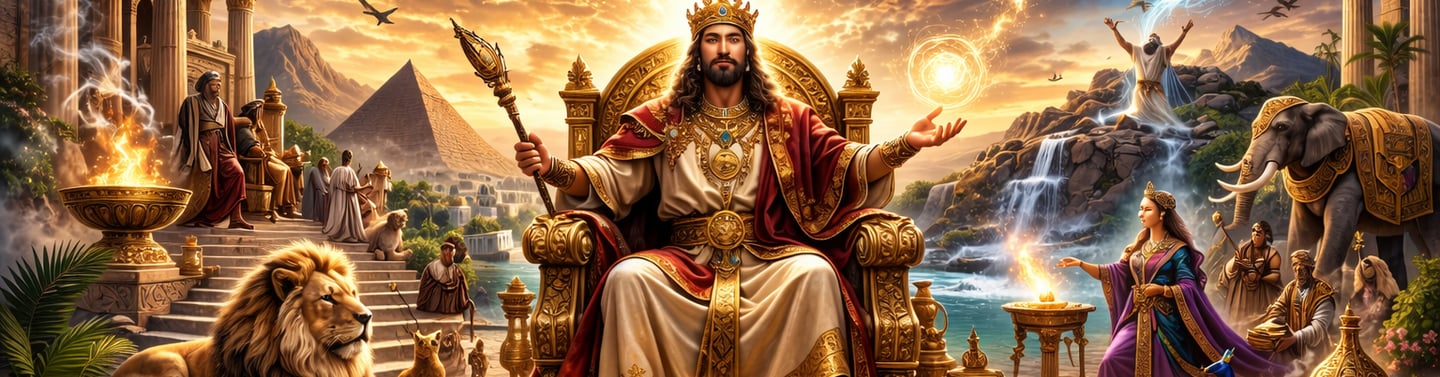
Of all the magician-kings in the history of the world, none casts a longer shadow than Solomon, son of David, lord of Jerusalem. His name is threaded through Jewish, Christian, Islamic, and Gnostic tradition as the supreme master of esoteric knowledge, the man who spoke with animals, commanded demons, bound spirits to his will, wore a ring of incomprehensible power, and built a Temple that was itself a magical instrument of cosmic proportion. The historical Solomon, a tenth-century BCE Israelite monarch of remarkable administrative and diplomatic gifts, was almost immediately transformed by legend into something far larger: an archetype of the philosopher-king whose wisdom was not merely political or moral but operative, a power that bent the fabric of the natural and supernatural world.
The Biblical Foundation
The biblical portrait of Solomon in 1 Kings and 2 Chronicles establishes the foundations of his legendary identity. His wisdom is granted by God in a dream at Gibeon, where Solomon asks not for wealth or power but for “an understanding heart” to discern between good and evil. The gift exceeds his request: he is given a breadth of wisdom “like the sand on the seashore,” surpassing all the wise men of the East and of Egypt. He speaks three thousand proverbs and a thousand and five songs; he discourses on trees, animals, birds, creeping things, and fish. This last detail is crucial for the magical tradition: knowledge of the natural world, including the secret natures and sympathies of all living things, was the foundation of ancient natural magic.
The famous judgment of the two mothers, the visit of the Queen of Sheba, the building of the Temple, all of these narrative elements fed the esoteric imagination. The Temple itself, built with the aid of a craftsman named Hiram of Tyre and constructed according to precise divine specifications, became a symbol of sacred architecture, a building whose proportions encoded cosmic truth. For later Kabbalists, each element of the Temple corresponded to a level of the divine reality; for Freemasons, Solomon’s Temple is the founding myth of the craft. The building was not merely a house of worship; it was a machine for accessing the divine.
The Ring and the Seal
The most important single magical instrument associated with Solomon is his ring, the Seal of Solomon, a signet of divine manufacture bearing the Name of God (or, in later tradition, the full Tetragrammaton, or a six-pointed star formed from two interlocking triangles, or a pentagram). In the Talmudic and early medieval Jewish sources, the ring is given to Solomon by God or an angel, and it is this ring that grants him his incomparable power over the supernatural world. With it, he could command any spirit, compel obedience from any demon, and seal them in vessels or beneath the earth.
The Seal of Solomon as a magical symbol migrated across traditions with remarkable fluency. In Islamic sources, the ring carries the Greatest Name of God and gives Solomon dominion over the djinn, the wind, and all created things. In the Greek Magical Papyri, Solomonic seals appear as apotropaic devices. The hexagram that came to bear Solomon’s name became one of the most widely used protective and operative symbols in Western and Middle Eastern magic, appearing on amulets, talismans, grimoires, and sacred architecture across three continents and fifteen centuries. The five-pointed star, the pentagram, was equally associated with him and carried the same authority.
The signet ring also appears in the dramatic story of its theft: the demon Asmodeus, in some tellings, steals Solomon’s ring and takes his place on the throne while Solomon wanders as a beggar. Only when the ring is recovered does Solomon’s power and identity return. The story encodes a deep magical principle, that the master of spirits is not invulnerable, that even supreme magical authority can be temporarily eclipsed, and that identity itself is bound up with one’s relationship to sacred power. It is also, in its way, an initiatory myth: the king stripped of everything must rediscover his own sovereignty from the ground up.
The Testament of Solomon
The most extraordinary document of Solomonic magic from antiquity is the Testament of Solomon, a Greek text whose earliest versions date to perhaps the first through third centuries CE, though it continued to be expanded and revised well into the Byzantine period. The text presents itself as Solomon’s first-person account of the building of the Temple, told primarily as a series of encounters with demons who are summoned before him, interrogated about their nature and evil activities, bound by divine authority, and then put to work on the Temple’s construction.
Each demon in the Testament has a distinctive character, function, and weakness. Ornias, the first demon encountered, is a vampiric spirit who harasses a young worker; Solomon receives his ring from the angel Michael and uses it to subdue him. Beelzeboul, lord of the demons, is brought before Solomon and reveals the entire structure of the demonic hierarchy. Asmodeus, the great demon of lust and destruction, is subdued by the angel Raphael and the smoke of a fish’s liver and gall, a detail drawn directly from the Book of Tobit. Each demon, bound and questioned, becomes a source of esoteric knowledge about the nature of evil, disease, and spiritual obstruction.
The Testament’s demonology is sophisticated and systematic in ways that would profoundly influence later Western magic. The demons are organized, have specific domains, fear specific angels, and can be controlled by specific divine Names and ritual procedures. This becomes the template for the medieval and Renaissance grimoire tradition: the magician who knows the true name, the nature, and the corresponding heavenly force for each spirit can compel it to serve rather than harm. Knowledge is protection; knowledge is power. The text also preserves astrological and astral-magical material, associating demons with planetary influences and celestial movements.
Solomonic Demonology and the Goetia
The Grimoiric Tradition
The legacy of the Testament flows directly into the great grimoires of the medieval and early modern period, the most influential of which bear Solomon’s name explicitly. The Key of Solomon (Clavicula Salomonis) is a comprehensive magical manual, surviving in numerous manuscripts from the late medieval period, containing instructions for the creation of magical instruments, the preparation of the operator, the timing of operations according to planetary hours, and the conjuration, binding, and dismissal of spirits. Despite its Solomonic framing, the text draws on a vast range of sources: Neoplatonic theurgy, Jewish magical practice, Arabic astrological magic, and Christian ceremonial forms.
Even more notorious is the Lemegeton, or Lesser Key of Solomon, a seventeenth-century compilation whose first book, the Goetia, provides a detailed catalog of seventy-two demons bound by Solomon in a brass vessel and cast into a lake. Each demon has a name, a rank, a seal, a specific power, and a number of legions under its command. Bael, Agares, Vassago, Gaap, Furcas, the list reads like a bureaucratic directory of the infernal world, which is exactly how it was understood to function. The magician who knows these entries and performs the correct ritual preparations can open the vessel, call the demon forth, and compel it to perform the desired work before binding it again.
The Goetia has had an extraordinary afterlife. It was translated and published by Aleister Crowley in 1904 and became a foundational text of modern ceremonial magic. Its demons have been the subject of theological debate, psychological interpretation (the Jungian reading of the demons as autonomous complexes), and serious practical engagement by generations of magicians. Whatever one makes of the metaphysics, the text represents an enormous cultural investment in the idea that Solomon had mastered the entire spectrum of spiritual power, not by avoiding the dark forces but by knowing them completely and holding authority over them.
Asmodeus and the Architecture of Desire
Among all the demons in the Solomonic tradition, Asmodeus holds a special place. He appears in the deuterocanonical Book of Tobit as a demon of destructive passion who kills seven successive husbands of Sarah before being driven off by Raphael. In the Testament of Solomon, he is more fully developed: a great king among demons, associated with the constellation of the Great Bear, who causes husbands and wives to quarrel, brings about murders through beautiful women, and destroys marriages. Yet he is also compelled to reveal magical secrets, notably the existence of a worm that can cut stone without iron, which Solomon uses in the Temple’s construction (iron being ritually prohibited in the sanctuary).
The relationship between Solomon and Asmodeus in rabbinic tradition is unexpectedly intimate and complex. The Talmud (Gittin 68) contains an extended narrative in which Solomon and Asmodeus engage in something approaching philosophical dialogue, the demon serving the king, outwitting him, teaching him, and finally humbling him. Asmodeus is not simply an enemy but an adversary in the older sense: a challenger who sharpens the hero by opposing him. This nuance is characteristic of the Solomonic tradition’s approach to demonic power generally: the aim is not to destroy it but to understand it, bind it into proper relationship, and turn it toward constructive ends.
Solomon in Islamic Tradition
In the Quran, Solomon (Sulayman) is a prophet of God whose dominion over the wind, the djinn, and the animals is an explicit divine gift. Sura 27, “The Ant,” contains the famous episode in which Solomon overhears an ant warning her colony of his approaching army, and he laughs with delight and prays for gratitude. He commands a djinn to bring him the throne of the Queen of Sheba (Bilqis) from Yemen before she can arrive in Jerusalem, an act of miraculous transportation. Birds serve as his messengers; the hoopoe carries dispatches; armies of djinn labor at his command.
Islamic magical tradition built extensively on this Quranic foundation. The djinn-binding arts attributed to Solomon became a central concern of Islamic occultism, and texts like the Shams al-Ma‘arif (The Sun of Gnosis) by al-Buni, one of the most influential magical compendia in the Arabic-speaking world, draws heavily on Solomonic authority for its conjurations and talismanic workings. The “Seal of Solomon”, the hexagram, appears throughout Islamic talismanic art. Solomon’s authority over the hidden world was not a Jewish or Christian claim alone but a pan-Abrahamic conviction, a shared mythological heritage of the three great religions of the Near East.
Solomon, Wisdom, and the Kabbalistic Tradition
In Jewish mysticism, Solomon’s magical authority is inseparable from his relationship to divine Wisdom, Hokhmah, and in later Kabbalistic terminology, the entire structure of the Sephiroth. The Book of Proverbs, attributed to Solomon, begins with the famous personification of Wisdom as a woman calling from the heights, who was with God at the creation of the world, delighting before him as his “master craftsman.” This figure of divine Wisdom becomes, in the Kabbalistic system, the second Sefirah of the Tree of Life, and Solomon’s legendary intimacy with her is the source of his power: he knows the deep structure of reality because he has entered into relationship with the creative intelligence that underlies it.
The Song of Solomon, the erotic lyric poem attributed to him, was read by mystical interpreters in both Jewish and Christian tradition as an allegory of the soul’s union with the divine. Origen wrote a massive commentary on it as the supreme text of mystical theology; the Zohar returns to it again and again as an image of the union between the Holy One and the Shekhinah, the divine presence. Whether the historical Solomon composed it or not is beside the point for this tradition: the song bore his name, and his name was synonymous with the knowledge of love in its deepest metaphysical sense, the eros that moves the universe, the force that Dante described as “the love that moves the sun and the other stars.”
Freemasonry and the Living Temple
No tradition has made more of the Solomonic legacy in the modern world than Freemasonry, which takes the construction of Solomon’s Temple as its central founding myth and operative symbol. The figure of Hiram Abiff, the master builder who is murdered by three ruffians seeking the Master’s Word and raised from death by King Solomon himself, is the initiatory drama at the heart of Masonic ritual. The candidate re-enacts Hiram’s death and resurrection, identifying with the architect whose secret knowledge cannot be destroyed even by violence, whose integrity is the foundation stone of the Temple itself.
The Masonic use of Solomon is theurgical in a precise sense: it employs the mythological material of his story as a transformative ritual technology, a means of re-shaping the consciousness and character of the initiate. Solomon’s Temple becomes the interior temple, the perfected human soul. The columns Jachin and Boaz, the checkered pavement, the blazing star, all carry layers of esoteric symbolism that link the physical architecture of the Temple to the architecture of cosmos and self. This is the Solomonic tradition working at its most philosophically ambitious: using the legend of a king’s building project as a map of the path from rough stone to polished, from uninitiated to illuminated.
Legacy
The magic of Solomon is, in its deepest dimension, a philosophy of authority: the proposition that genuine wisdom confers genuine power, that the one who truly knows the inner nature of things, of spirits, of the natural world, of the divine Names, of the human soul, can work with those things rather than against them, binding chaos into order, turning darkness into service, making even the most dangerous forces labor toward the good. This is why his most characteristic magical act is not destruction but construction: he builds the Temple. The demons quarried the stone, and the Temple stood.
From the Testament of Solomon to the Goetia, from the Kabbalistic Tree to the Masonic lodge, from Islamic djinn-lore to Renaissance ceremonial magic, the figure of Solomon has served as the supreme emblem of operative wisdom, the assurance that the universe’s hidden powers are not simply chaos to be feared but an order to be known, and that the human being who achieves sufficient depth of understanding can stand at the center of that order and speak with authority. His ring, his seal, his name itself became instruments of that authority. To invoke Solomon was to invoke the idea that wisdom is not merely contemplative but sovereign, that the philosopher-king is not a metaphor but a real possibility, and that the Temple of genuine knowledge can be built, in this world, by human hands.
I Believe in Magic
© SDBEST LLC, 2025. All rights reserved.
Privacy Policy
Sponsorship Disclosure
Cookie Policy
Disclaimer