The Magic of John Dee
Royal Astrologer, Angel-Caller, and Architect of Angelic Conversation
In the long history of Western magic, no figure is more haunting, more contradictory, or more thoroughly documented than John Dee of Mortlake, mathematician, astrologer, cartographer, navigator’s advisor, spy, philosopher of nature, and for the last two decades of his active intellectual life, the most devoted angelic communicant the Western tradition has ever produced. Born in London in 1527 and dying in poverty and obscurity at Mortlake in 1608 or 1609, Dee lived through the full arc of the English Reformation and its aftermath, served four Tudor monarchs with varying degrees of favor and suspicion, assembled the greatest private library in Elizabethan England, corresponded with the leading scholars and navigators and monarchs of Europe, and then spent years kneeling at a scrying table while a sequence of scryers looked into a polished stone or a mirror and reported what the angels said.
The contrast between these two halves of his career has fascinated and troubled scholars ever since. How does the man who helped develop the theoretical foundations of English navigation, who wrote the preface to the first English translation of Euclid, who advised Drake and Frobisher, who was consulted by Elizabeth I on the date of her coronation and the significance of a comet, how does this man become the obsessive keeper of hundreds of thousands of words of angelic dictation, the receiver of a new universal language claimed to predate Hebrew, the supplicant who ended his continental wanderings with his family in disorder and his fortune gone? The answer, when it comes, is not a story of decline from rationality into superstition. It is a story of a single unified ambition, pursued with absolute consistency across an entire lifetime, whose methods changed but whose goal never did: to know the hidden structure of the world and to act upon that knowledge for the reformation of Christendom and the benefit of humanity.
The Scholar and the Court
John Dee entered St. John’s College, Cambridge in 1542, at the age of fifteen, and distinguished himself immediately by the ferocity of his study, he later recalled sleeping only four hours a night and spending eighteen hours a day reading. He studied Greek, Latin, mathematics, and the full range of the new humanist curriculum, and made his first continental journey in 1547, visiting Louvain and meeting the cartographer Gemma Frisius and the geographer Gerard Mercator, friendships that would shape his lifelong interest in navigation and geography. He lectured on Euclid in Paris to audiences of hundreds, turned down university posts in France and England, and returned to establish himself in London as an independent scholar and consultant.
His early career was not without danger. In 1553, under the reign of the Catholic Queen Mary, he was arrested on charges of “enchantments” and “calculating”, the latter charge referring to casting horoscopes, which could be interpreted as an attempt to foreknow the sovereign’s death. He was examined by the Privy Council, imprisoned briefly, and eventually released, but the episode established a pattern that would recur throughout his life: the man of learning whose knowledge of hidden things made him simultaneously valuable and suspect, consulted by the powerful and feared by the same.
Under Elizabeth, who came to the throne in 1558, Dee found a more congenial climate. He was asked to select an auspicious date for her coronation, the first of many astrological consultations, and became a regular if never fully institutionalized presence at court. He proposed ambitious projects: a national library that would collect and preserve the manuscripts dispersed by the dissolution of the monasteries; a program of cartographic and navigational research to support English expansion; a reformation of the Julian calendar. Most of these proposals were politely received and then ignored. Dee was valued for his specific knowledge and his willingness to be consulted on arcane matters, but he was never given the institutional support or the court position that would have secured his finances and given him the resources his ambitions required.
The Library at Mortlake
At his house in Mortlake on the Thames, Dee assembled a library that contemporaries described with something approaching awe. By the early 1580s it contained approximately four thousand books and manuscripts, at a time when the Bodleian Library at Oxford held perhaps half that number. It covered mathematics, navigation, astronomy, natural philosophy, medicine, alchemy, Kabbalah, Hermeticism, Neoplatonism, theology, history, languages, and much more. It was the greatest working research library in private hands in Elizabethan England, and scholars, navigators, and courtiers came to Mortlake to use it.
The library is the best material evidence for the unity of Dee’s intellectual project. Its contents were not the miscellaneous accumulation of a collector but the purposefully assembled resources of a man pursuing a specific research program: the investigation of the hidden principles underlying all knowledge, with the aim of producing a unified science that would reconcile natural philosophy, mathematics, Hermeticism, Kabbalah, and Christian theology into a single coherent system. This was the Renaissance Hermetic program in its fullest ambition, the dream of a prisca sapientia, an original ancient wisdom, that had been fragmented by time and historical catastrophe and could be reassembled by the sufficiently learned and sufficiently dedicated scholar.
When a mob ransacked the house during one of his absences in 1583, scattering or destroying books and instruments accumulated over decades, Dee described the loss with a grief that suggests how completely his library was his intellectual self. The destruction was not merely financial but existential: the tools of his life’s work, gone. He never fully recovered the library, and the subsequent years of continental wandering were marked by the progressive narrowing of his resources that would end in the poverty of his final decade.
The Monas Hieroglyphica
In 1564 Dee published the Monas Hieroglyphica, the Hieroglyphic Monad, dedicated to the Habsburg Emperor Maximilian II and composed, Dee claimed, in twelve days of concentrated inspiration. The text presents and expounds a single composite symbol, the Monas, which combines the signs of the sun, moon, and the four elements into a unified glyph that Dee presents as encoding the deepest secrets of mathematics, astronomy, alchemy, Kabbalah, and natural philosophy. The Monas is a magical symbol in the precise Renaissance Hermetic sense: a visual form that participates in the reality it represents, whose contemplation and operation generate transformations in the practitioner and in the world.
The Monas Hieroglyphica is one of the most difficult texts in the entire Western esoteric tradition, deliberately obscure, packed with multiple simultaneous levels of meaning, addressed explicitly to a reader who has already achieved a high degree of initiation in the relevant disciplines. Dee himself described it as containing mysteries too great to be committed to ordinary writing, and subsequent commentators have struggled to extract a fully coherent exposition from it. What is clear is its ambition: Dee was claiming that the structure of reality itself could be encoded in a single symbol, and that the scholar who mastered that symbol had in principle mastered the unifying key to all knowledge.
The text was received with admiration by the learned of Europe, Maximilian reportedly studied it for hours when it was presented to him, and it remained in circulation and influence throughout the following two centuries. Leibniz knew it; the Rosicrucian manifestos that appeared in the early seventeenth century were clearly influenced by it; it has been seen as a precursor of symbolic logic and of the kind of universal philosophical language that Leibniz himself pursued. Whether these connections are precisely correct, the Monas demonstrates that Dee’s magical work was not separable from his mathematical and philosophical work, it was the same work, pursued at the level of symbol rather than number.
The Angelic Conversations
In 1581 John Dee, then fifty-four years old, wealthy in books and instruments but poor in money and frustrated in his ambitions for a great institutional role, began a new phase of his work. He had long been interested in the angelic magic described in the medieval grimoire tradition and theorized in the Neoplatonic hierarchy of Pseudo-Dionysius and the Hermetic literature. He had attempted scrying, the art of gazing into a reflective surface to perceive visions or receive communications from spiritual beings, with limited success using his own faculties. Now he found, in a series of practitioners beginning with Barnabas Saul and culminating in Edward Kelley, the scrying gift he himself lacked.
Edward Kelley, who arrived at Mortlake in March 1582, was a complex and troubling figure: probably in his mid-twenties, possibly a forger (his ears had been cropped, the standard punishment for fraud), certainly possessed of extraordinary psychological gifts that made him either a genuine medium or an exceptionally convincing performer. With Kelley as his scryer and himself as the recorder and interrogator, Dee initiated the most intensive and systematic program of angelic communication in the history of Western magic. It would continue, with interruptions, for seven years.
The Enochian System
The communications that Kelley received, or produced, or channeled, through the scrying stone were recorded by Dee in a series of diaries that survive in the British Library and constitute one of the most extraordinary documents in the history of Western esotericism. Over hundreds of sessions, the angels dictated a complete system: a new universal language, which Dee called Angelic and which later tradition named Enochian; a set of forty-nine square tablets of letters whose combination generated the language’s words and names; a hierarchy of angels organized into calls or keys; a cosmology of aethyrs or regions through which the practitioner could ascend; and a series of specific operations for working with the angelic powers.
The language itself is remarkable. Enochian has a consistent grammar, a phonology, a vocabulary of approximately eight hundred words, and syntactic structures that do not straightforwardly mirror any known human language. Whether it was spontaneously generated by Kelley’s unconscious mind, gradually constructed by the two men in a kind of collaborative trance, or genuinely received from non-human intelligence is a question that has never been resolved and probably cannot be. What is beyond dispute is that it is not simply random nonsense: it has enough internal consistency to have been used as a working magical language by practitioners from the Elizabethan period to the present, most notably by the Golden Dawn in the nineteenth century and by Aleister Crowley, who explored the aethyrs systematically in the early twentieth century and recorded the results in The Vision and the Voice.
The theological framework of the Enochian system is Christian and eschatological in character: the angels who communicated with Dee identified themselves as the same angels who had spoken with the biblical patriarch Enoch, before the Fall of Man had severed direct communication between the human and angelic orders. The purpose of their renewed communication with Dee was explicitly millenarian, the preparation of a great reformation of knowledge and religion that would precede and enable the final age of the world. Dee was not merely receiving spiritual instruction for his personal edification; he was, as he understood it, being recruited as an instrument for the transformation of civilization.
The Spiritual Diaries
Dee’s records of the angelic sessions are not only a document of the communications themselves but a journal of extraordinary psychological and spiritual candor. He records his doubts, his fears, his moments of exaltation and despair, his arguments with Kelley, his prayers and vigils, his interpretations of what the angels told him. He was fully aware of the possibility that the communications might be deceptive, that demons might be counterfeiting angels, or that Kelley might be fabricating, and the diaries are punctuated by anguished self-examination on this point. Yet he could not stop. The communications answered too precisely the deepest questions of his life, promised too directly the great role he had always believed was his vocation, for him to abandon them even when they led him into situations of profound difficulty and embarrassment.
The most painful of these situations was the infamous “wife-swapping” episode of 1587. The angels, through Kelley, delivered a command that the two men and their wives should hold all things in common, including their spouses. Dee’s anguished response, recorded in his diary with painful honesty, reveals the full torment of a man caught between his rational understanding that this was probably wrong and his conviction that he could not simply override what the angels commanded. He eventually complied. The marriage of John and Jane Dee apparently survived the episode, but the partnership with Kelley did not long outlast it. By 1589 the two men had permanently parted, and Dee’s access to the angelic system, which depended entirely on Kelley’s scrying gift, effectively came to an end.
The Continental Wanderings
From 1583 to 1589 Dee and Kelley, with their families, wandered through the courts of Europe: in the entourage of the Polish nobleman Albert Laski, who had visited Mortlake and become convinced that Dee was the man who would reveal the philosopher’s stone to him; at the court of Emperor Rudolf II in Prague, who received them with guarded fascination; in Bohemia under the patronage of the nobleman Vilém Rozmberk. The angels had told Dee that his mission was European and imperial in scope, that he was to bring the angelic message to the great powers of the continent and participate in the transformation of Christendom.
The reality was considerably less glorious. Rudolf II was interested but cautious, and his Papal Nuncio pressured him to expel the English magicians as dangerous heretics. The philosopher’s stone that Laski and others expected never materialized. Dee’s money ran out; he was dependent on the patronage of men who expected practical alchemical results that neither he nor Kelley could deliver. Kelley, meanwhile, was developing his own interests and ambitions, and the communications became increasingly strained and confused. The wife-swapping episode, the quarrels, the dwindling resources, the continental adventure ended not in the great reformation Dee had envisioned but in failure, poverty, and the destruction of the partnership that had made the angelic work possible.
Return, Ruin, and the Final Years
Dee returned to England in 1589 and was appointed Warden of Christ’s College, Manchester, a position that proved entirely unsuitable for a man of his temperament and entirely inadequate for his financial needs. The college was in disorder, its fellows contentious and ungovernable, its resources depleted. Dee spent six miserable years trying and failing to reform it, surrounded by colleagues who despised him and a local population that regarded him with popular superstition as a conjuror and a wizard. He had to defend himself publicly against accusations of diabolism on multiple occasions.
He resigned the wardenship in 1605 and returned to Mortlake, now in his late seventies, his library largely dispersed, his scientific instruments gone, his wife dead of the plague in 1604, his political connections exhausted. He petitioned James I for relief from the accusations of conjuring that continued to follow him and for some acknowledgment of his lifetime of service to the English crown. James, who had written his own treatise on witchcraft, the Daemonologie, was not inclined to be sympathetic to anyone associated with angelic magic.
Dee spent his final years selling books from what remained of his library to meet his daily expenses. The four-thousand-volume collection that had been the wonder of Elizabethan England was reduced, volume by volume, to bread and fuel. He died in December 1608 or early 1609, the parish record is unclear, at Mortlake, probably in his eighty-first year. He was buried in the chancel of the church at Mortlake, without monument. No contemporary account of his death or final hours survives. The man who had spoken with angels, advised Elizabeth, and dreamed of reforming Christendom died in obscurity, cold, and alone with his diminished shelves.
The Instruments of Magic
Among the physical objects associated with Dee’s magical practice, several survive and are now among the most evocative artifacts of the Western esoteric tradition. The obsidian mirror, a circular disk of polished Aztec obsidian, probably brought to England as a curiosity from the New World, is preserved in the British Museum, along with a crystal ball that may have been used as a scrying stone in the sessions. A wax seal engraved with the angelic name PELE, one of several such seals that functioned as the material infrastructure of the angelic communications, also survives. These objects carry an extraordinary charge: handled by Dee and Kelley, gazed into by Kelley for hundreds of hours while Dee recorded what he saw there, they are the physical residue of one of the most sustained and serious attempts in Western history to establish communication with non-human intelligence.
The scrying table, a folding table on which the wax seals were arranged in a specific pattern as the material basis for the operations, is described in the diaries in sufficient detail to be reconstructed and has been reconstructed by modern practitioners of Enochian magic. The entire apparatus, stone, table, seals, the elaborate preparatory prayers and fastings, constitutes a magical technology of considerable sophistication, designed to create the conditions under which the boundary between the human and angelic orders could be made permeable. Whether or not it succeeded in that aim, it represents an extraordinary flowering of the Renaissance Hermetic tradition’s conviction that the human mind, properly prepared and properly oriented, could reach beyond the boundaries of the natural world.
Dee and the Rosicrucian Current
The Rosicrucian manifestos that appeared in Germany between 1614 and 1616, the Fama Fraternitatis, the Confessio Fraternitatis, and The Chymical Wedding of Christian Rosenkreuz, describe an invisible brotherhood of learned sages working for the reformation of knowledge and religion, possessing a universal science that reconciles all traditions, and waiting for the moment when the world would be ready for their public emergence. Whether or not Dee had any direct connection to the authors of these texts, and the question remains actively debated, the Rosicrucian program reads in almost every detail like the fulfillment of Dee’s own vision as articulated in the angelic diaries and the Monas Hieroglyphica.
The scholarly consensus, developed most fully by Frances Yates in her influential studies of the Hermetic tradition, is that the Rosicrucian current drew heavily on the Dee circle and specifically on the period of Dee and Kelley’s presence at the court of Rudolf II and in the Bohemian lands. The intellectual and spiritual ferment of that environment, the combination of Hermeticism, Kabbalah, alchemy, natural philosophy, and millenarian expectation, is precisely the atmosphere from which the Rosicrucian texts emerge. Dee may not have written them, but he breathed their air and, in some sense, created it.
Legacy: The Enochian Tradition and Beyond
The afterlife of John Dee’s magical work is one of the most remarkable stories in Western esotericism. The angelic system he and Kelley received lay largely dormant for two centuries after his death, known primarily from Meric Casaubon’s 1659 publication of a True and Faithful Relation of What Passed for Many Years Between Dr. John Dee and Some Spirits, a publication intended by Casaubon to discredit Dee and demonstrate the dangers of spiritual delusion, but which had the unintended effect of preserving and disseminating the system to precisely the audience most likely to take it seriously.
In the late nineteenth century the Hermetic Order of the Golden Dawn incorporated the Enochian system into its grade work and practical curriculum, developing the system extensively and integrating it with Kabbalah, astrology, and Tarot. Through the Golden Dawn, Enochian magic passed to Aleister Crowley, who explored the thirty aethyrs described in the angelic communications in a series of visionary workings that he published as The Vision and the Voice, one of the most sustained pieces of magical phenomenology in the modern tradition. From Crowley the system passed into the broader current of twentieth-century Western magic, where it remains one of the most widely practiced and seriously studied of all magical systems.
Beyond its direct magical legacy, Dee’s significance in the history of ideas is substantial and still being assessed. His mathematical and navigational work contributed directly to the Elizabethan expansion. His library and his intellectual network helped shape the flow of ideas between the European continent and England at a crucial moment of the Renaissance. His concept of the British Empire, a phrase he may have coined, and his advocacy for English naval power had long-term political consequences. And his angelic work, whatever one makes of its metaphysical claims, produced one of the most extraordinary documents of religious and psychological experience in the English language: a record of a man who gave everything he had, including his peace of mind, his marriage, his fortune, and his professional standing, to the pursuit of a direct encounter with divine intelligence.
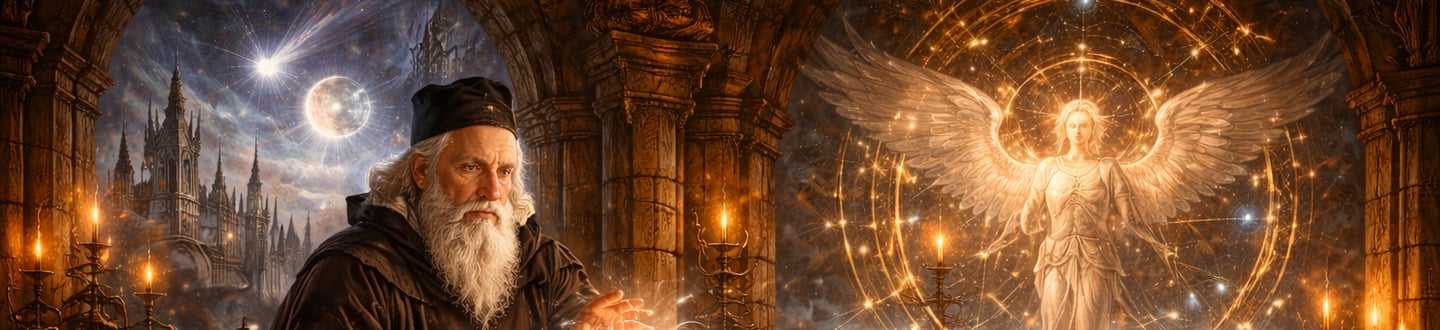
He did not succeed in reforming Christendom. He did not find the philosopher’s stone. He did not receive the universal scientific key that would reconcile all knowledge. He died in poverty, selling his books. But the diaries remain, and the language remains, and the system remains, and in them the figure of John Dee remains, kneeling at the scrying table in the candlelight at Mortlake, writing down what the angels said, wholly and irreversibly committed to the proposition that the boundary between the human and the divine was real, was thin, and could be crossed by the sufficiently pure, the sufficiently learned, and the sufficiently desperate will.
I Believe in Magic
© SDBEST LLC, 2025. All rights reserved.
Privacy Policy
Sponsorship Disclosure
Cookie Policy
Disclaimer